What is the Stoichiometry Calculator?
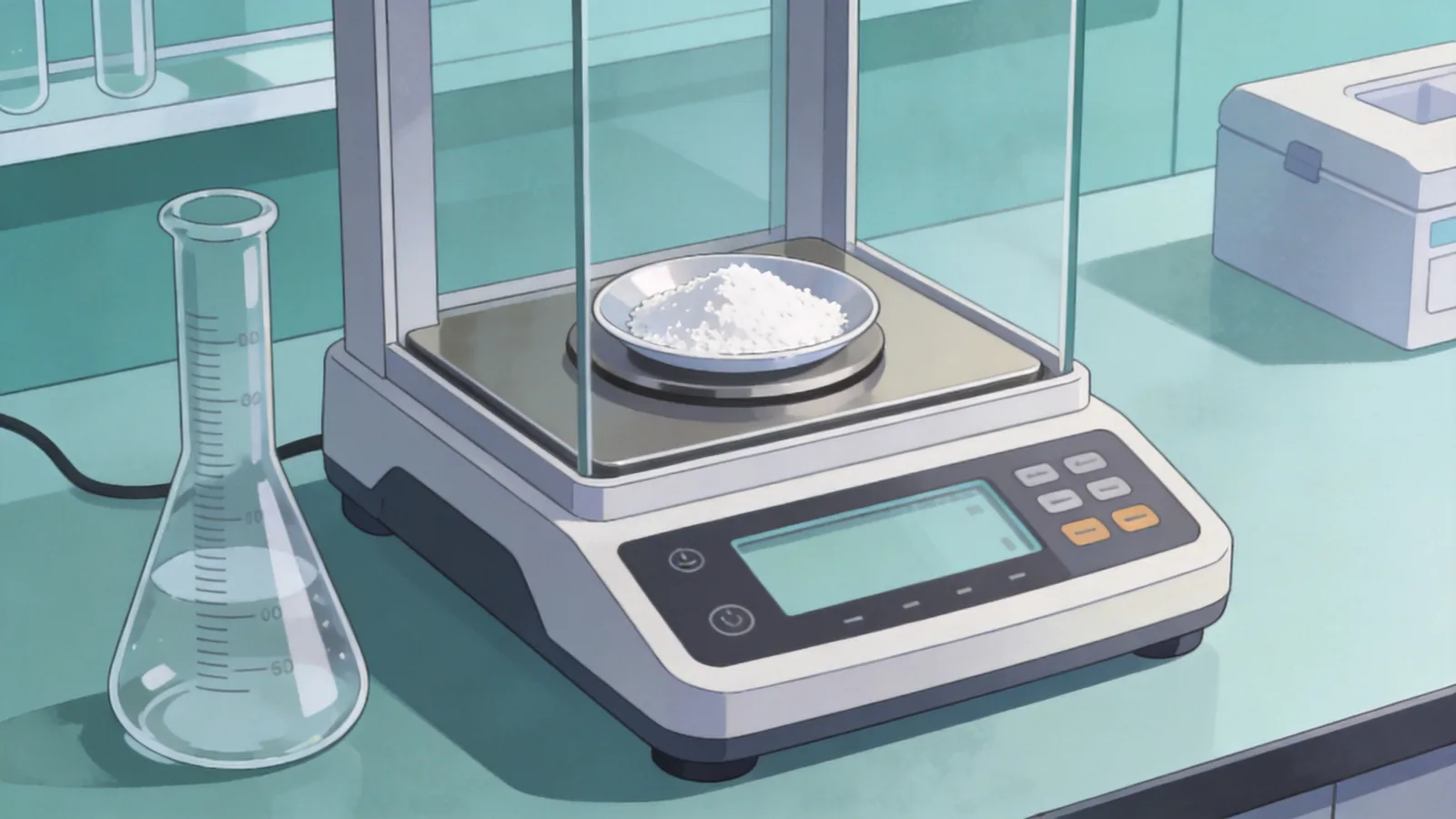
Stoichiometry is the branch of chemistry that relates the amounts of reactants and products in a chemical reaction through balanced equations and molar relationships. At its foundation lies the mole concept: chemists count particles in units of moles because individual atoms and molecules are far too numerous to tally directly. One mole contains exactly 6.02214076 × 10²³ entities, a quantity known as Avogadro's number.
Before any stoichiometric calculation can proceed, you must know the molar mass of each substance involved. Molar mass is the mass of one mole of a compound, expressed in grams per mole (g/mol). It is computed by summing the atomic masses of every atom in the chemical formula, weighted by subscripts. For example, water (H₂O) has a molar mass of approximately 18.015 g/mol because two hydrogen atoms (1.008 g/mol each) plus one oxygen atom (15.999 g/mol) combine to that total.
In general chemistry laboratories, stoichiometry governs how much reagent to weigh out, how to prepare solutions of known concentration, and how to interpret analytical results. A student preparing 250 mL of 0.100 M NaCl must first convert volume to liters, multiply by molarity to find moles of solute, then multiply moles by the molar mass of NaCl (58.44 g/mol) to determine the required mass. Without accurate molar mass values, every subsequent calculation in the experiment becomes unreliable.
Stoichiometry also appears throughout homework sets involving mass-percent composition, empirical formulas, and mole-to-mole conversions from balanced equations. When a problem asks what mass of oxygen is produced from 10.0 g of potassium chlorate, the workflow begins with molar mass, proceeds through mole ratios from the balanced equation, and ends with a mass conversion. The Stoichiometry Calculator on Online Science Tools automates the molar mass step so you can focus on the logical chain of conversions rather than arithmetic errors in atomic mass lookups.
Beyond introductory courses, stoichiometry underpins quantitative analysis, environmental chemistry, and materials science. Whether you are determining the formula of an unknown compound from combustion data or scaling a synthesis from milligram to kilogram quantities, the same mass–mole–particle relationships apply. Mastering these conversions builds the quantitative reasoning that distinguishes chemistry from descriptive science.
- Molar mass (M) links grams to moles: n = m / M
- Avogadro's number converts moles to particle count: N = n × Nₐ
- Mass percent shows each element's fractional contribution to a compound's total mass
- Balanced equations provide mole ratios between reactants and products
Formulas you will actually use
The core stoichiometric relationships connect mass, moles, and particle count through molar mass and Avogadro's number. For a compound with formula unit X, the molar mass is the weighted sum of constituent atomic masses.
M = Σ (nᵢ × Aᵢ)

where:
  M   = molar mass (g/mol)
  nᵢ  = number of atoms of element i in the formula
  Aᵢ  = standard atomic mass of element i (g/mol)

Mass ↔ moles:
  n = m / M          (moles from mass)
  m = n × M          (mass from moles)

Moles ↔ particles:
  N = n × Nₐ
  Nₐ = 6.02214076 × 10²³ mol⁻¹

Mass percent of element i:
% mass(i) = (nᵢ × Aᵢ / M) × 100%- Subscripts in a formula multiply the atomic mass of the preceding element or group.
- Parentheses indicate polyatomic groups whose total count is multiplied by the outside subscript.
- Hydrates are written with a dot separator (e.g., CuSO₄·5H₂O) and each part contributes to molar mass independently.
Step-by-step example: Molar Mass and Mole Conversion for Sulfuric Acid
A student needs to prepare a solution using 49.0 g of sulfuric acid (H₂SO₄). Determine the molar mass of H₂SO₄ and convert the given mass to moles.
- Identify the formula: H₂SO₄ contains 2 hydrogen, 1 sulfur, and 4 oxygen atoms.
- Look up atomic masses: H = 1.008, S = 32.06, O = 15.999 g/mol.
- Calculate molar mass: M = 2(1.008) + 32.06 + 4(15.999) = 2.016 + 32.06 + 63.996 = 98.072 g/mol.
- Convert mass to moles: n = m / M = 49.0 g / 98.072 g/mol = 0.4996 mol ≈ 0.500 mol.
- Verify mass percent: H contributes (2.016/98.072) × 100 = 2.06%, S contributes 32.68%, O contributes 65.26%.
Open the Stoichiometry Calculator on Online Science Tools, enter H2SO4 as the formula, and confirm the molar mass reads approximately 98.07 g/mol with the elemental breakdown matching your hand calculation. Then enter 49.0 g in the mass field to verify the tool reports about 0.500 mol. If you are continuing to a reaction problem, use the Chemical Equation Balancer to obtain coefficients and the Limiting Reagent Calculator for limiting reagent analysis.
Frequently asked questions
How do I convert grams to moles with the molar mass formula?
Use n = m / M. Enter the formula to get M (g/mol), enter the mass in grams, and read moles. The reverse is m = n × M. Particle count follows N = n × Nₐ with Avogadro’s number 6.02214076 × 10²³ mol⁻¹. That grams-to-moles conversion is the core of most stoichiometry calculator workflows for a single compound.
Why do I need molar mass before doing any stoichiometry problem?
Stoichiometry problems almost always require you to work in moles because balanced chemical equations express ratios in moles, not grams. Molar mass is the conversion factor that bridges the mass you can measure on a balance with the mole quantities that appear in the equation. Without it, you cannot move from a weighed sample to the mole ratio needed to find product yields or remaining reactants.
How do I enter hydrates and parentheses in a chemical formula?
Hydrates are written with a dot or middle dot between the anhydrous compound and the water molecules, such as CuSO4·5H2O or CuSO4.5H2O. The Stoichiometry Calculator treats each segment independently and sums their molar masses. For grouped atoms like calcium hydroxide, write Ca(OH)2—the parentheses ensure both oxygen and hydrogen are multiplied by two before the masses are added.
What is the difference between molar mass and molecular mass?
Molecular mass refers to the mass of a single molecule in atomic mass units (u), while molar mass is the mass of one mole of that substance in grams per mole. Numerically they are the same value when atomic masses are expressed in u, but molar mass carries the unit g/mol needed for stoichiometric calculations. For ionic compounds like NaCl, the term 'formula mass' is often used instead of molecular mass, but molar mass applies universally.
Can I use the Stoichiometry Calculator for mass-percent composition problems?
Yes. Once you enter a formula, the calculator displays each element's contribution to the total molar mass as a mass percentage. This is directly useful for empirical formula problems, purity checks, and verifying whether a sample matches an expected composition. Compare the percentages to experimental data from combustion analysis or spectroscopy to confirm your compound identity.
References & further reading
Standards bodies, university open courseware, and peer-reviewed references that align with the methods used on this page.
Keep learning with chemistry calculators, the math tools, and study guides on Online Science Tools.