Chemical equilibrium calculator (Kc, Kp, Q, ICE)
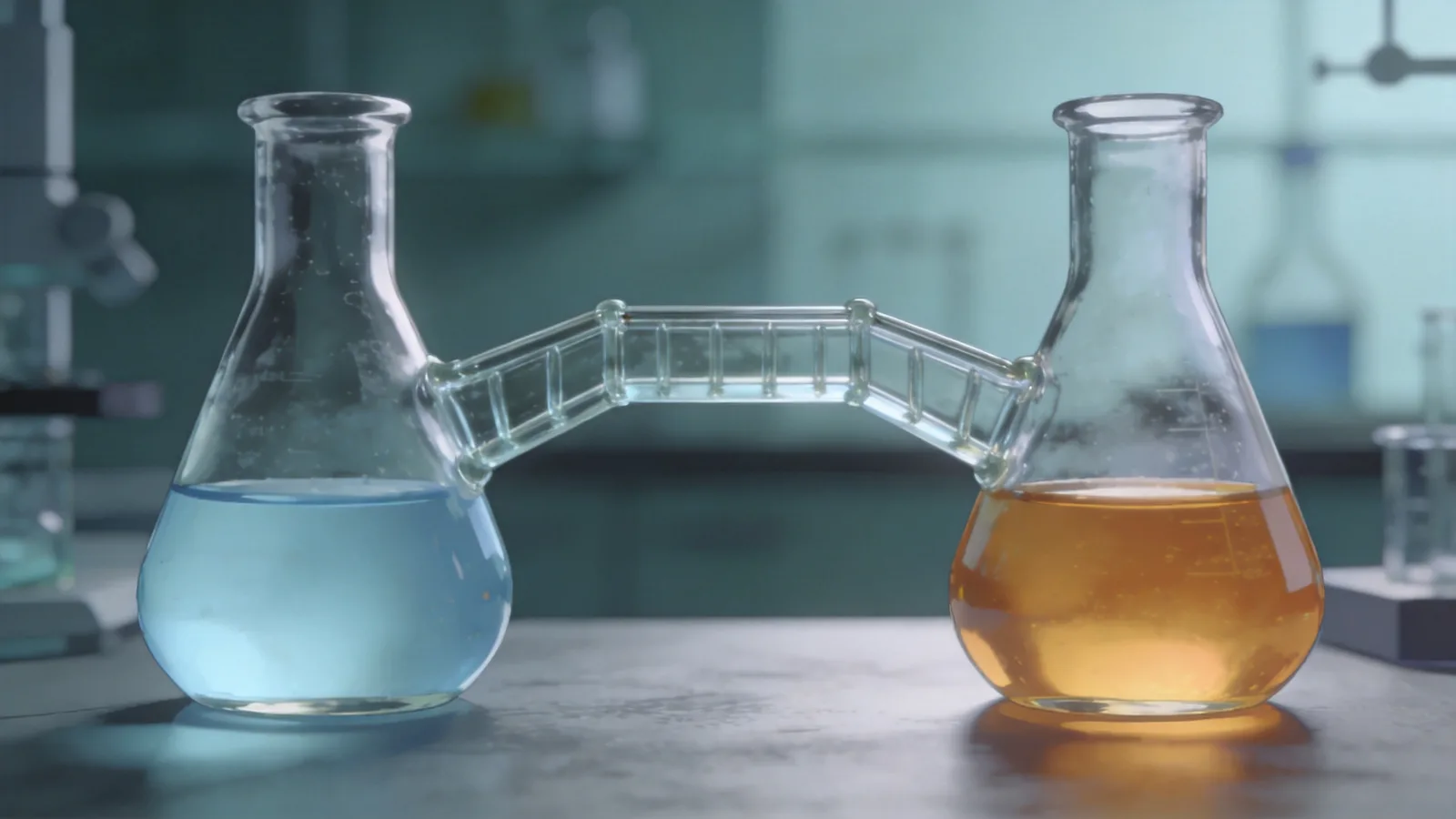
A chemical equilibrium calculator solves the same problem you meet on homework: given a reversible reaction and K, what are the equilibrium amounts? Macroscopically, concentrations stop changing once the forward and reverse rates match. The constant K fixes the ratio of products to reactants at that point; it does not say the reaction “stopped.”
Write Kc with molarities and stoichiometric exponents. Write Kp the same way with partial pressures when the problem is in atm (or bar, if your course uses that). The reaction quotient Q uses the identical algebra with whatever amounts you have right now. If Q < K, net reaction runs forward; if Q > K, it runs reverse until Q catches K.
Most students organize the algebra with an ICE table—Initial, Change, Equilibrium. Pick one extent variable x, apply the stoichiometry (±νx), substitute into K, and solve. Easy cases stay quadratic. Haber-style problems (N₂ + 3H₂ ⇌ 2NH₃) get messy fast; that is when a numerical solver saves time and catches sign errors.
This tool builds the ICE table, compares Q to K, and returns equilibrium concentrations. Use it to check a hand solution, not as a substitute for setting up the table yourself on an exam. For solubility equilibria use the Ksp calculator; for acid–base numbers use the pH calculator.
- Kc from concentrations (M); Kp from partial pressures
- Q vs K decides forward, reverse, or already at equilibrium
- ICE: every species changes by ±(coefficient)×x
- Gases (ideal): Kp = Kc(RT)^Δn, with Δn = gas moles products − reactants
Formulas you will actually use
For aA + bB ⇌ cC + dD. Keep units consistent—do not mix M and atm inside one K expression.
Kc = [C]^c[D]^d / ([A]^a[B]^b)          at equilibrium
Q  = same form with current amounts

Q < K → net forward
Q > K → net reverse
Q = K → equilibrium

ICE (extent x ≥ 0 in the forward direction):
  [A] = [A]₀ − a x
  [B] = [B]₀ − b x
  [C] = [C]₀ + c x
  [D] = [D]₀ + d x

Ideal gases:
  Kp = Kc (RT)^Δn
Δn = (c + d) − (a + b) (gas moles only)- Leave pure solids and pure liquids out of K; their activities are taken as 1.
- Reject any root that drives a concentration below zero.
- If K ≪ 1, the 5% / small-x shortcut may work—always check x against the starting concentration.
Step-by-step example: Simple ICE table, A ⇌ 2B
Start with [A]₀ = 1.00 M, no B, and Kc = 0.36 for A ⇌ 2B. Find the equilibrium concentrations.
- ICE: [A] = 1.00 − x, [B] = 2x.
- Kc = (2x)² / (1.00 − x) = 0.36 → 4x² = 0.36(1 − x).
- 4x² + 0.36x − 0.36 = 0. Positive root: x ≈ 0.258.
- So [A]eq ≈ 0.742 M and [B]eq ≈ 0.517 M.
- Check: (0.517)² / 0.742 ≈ 0.36. Good.
In the Chemical Equilibrium Calculator, enter A = 2B with Kc = 0.36 and initials 1.00 / 0. You should land near 0.742 M and 0.517 M.
Step-by-step example: Haber problem that needs a numerical root
N₂(g) + 3H₂(g) ⇌ 2NH₃(g), Kc = 0.50. Mix 1.00 M N₂ and 3.00 M H₂ with no NH₃. Find equilibrium amounts.
- [N₂] = 1 − x, [H₂] = 3 − 3x, [NH₃] = 2x (and 0 ≤ x ≤ 1).
- 0.50 = (2x)² / [(1 − x)(3 − 3x)³] = 4x² / [27(1 − x)⁴].
- Solve on a calculator or numerically: x ≈ 0.486.
- [N₂] ≈ 0.514 M, [H₂] ≈ 1.54 M, [NH₃] ≈ 0.972 M.
- Initial Q = 0 < K, so the net shift is forward—as expected with no product present.
Load N2 + 3H2 ⇌ 2NH3, Kc = 0.50, initials 1 / 3 / 0. Confirm the same equilibrium set and a forward direction from Q.
Step-by-step example: Convert Kc to Kp
Same Haber stoichiometry, Δn = −2. At 500 K, Kc = 0.060. Estimate Kp with R = 0.0821 L·atm/(mol·K).
- Kp = Kc(RT)^Δn = 0.060 × (0.0821 × 500)^(−2).
- RT = 41.05; (RT)² ≈ 1685.
- Kp ≈ 0.060 / 1685 ≈ 3.6 × 10⁻⁵.
Use the calculator’s Kc ↔ Kp conversion with Δn = −2, T = 500 K, and the same R. Expect Kp on the order of 10⁻⁵.
Frequently asked questions
Is this a chemical equilibrium calculator for ICE tables?
Yes. Enter the reaction, K (Kc or Kp), and starting amounts. The solver builds the ICE relations, compares Q with K, and reports equilibrium concentrations. It is meant for general chemistry / homework checks—not for activity-coefficient models or multiple simultaneous equilibria.
Can I use this as a reaction quotient calculator?
Yes. Q uses the same expression as Kc or Kp with your current amounts. The calculator reports Q, compares it with K, and tells you whether the net reaction runs forward, reverse, or is already at equilibrium.
How do I find equilibrium concentrations from Kc?
Set up an ICE table: write initial concentrations, let the change be ±(coefficient)×x, substitute the equilibrium line into Kc, and solve for x. This chemical equilibrium calculator does that algebra (including cases that are not a simple quadratic) and returns each equilibrium concentration.
Kc or Kp—which one do I type in?
Match the data you were given. Concentration tables → Kc. Partial-pressure tables → Kp. For ideal gases you can convert with Kp = Kc(RT)^Δn, but only after Δn is counted from gas coefficients alone.
What if Q is huge because a reactant is missing?
If a reactant concentration is zero while products are present, Q is formally infinite and the net reaction must run in reverse. The calculator treats that case: it shifts backward until K is satisfied (or reports that no physical root exists).
When is the small-x approximation safe?
When K is small enough that x ends up under roughly 5% of the smallest starting reactant concentration. Simplify (C − x) ≈ C, solve, then check the 5% rule. If you fail the check, keep the full polynomial—or use the numerical solver.
Does pressure change K?
Changing the total pressure (or volume) can shift gas-phase position by changing Q, but K itself stays put unless temperature changes. Temperature is what moves K; that is the van ’t Hoff idea behind endothermic vs exothermic equilibria.
References & further reading
Standards bodies, university open courseware, and peer-reviewed references that align with the methods used on this page.
See also: pH Calculator · Ksp Calculator · Phosphate Buffer Calculator
Keep learning with chemistry calculators, the math tools, and study guides on Online Science Tools.