Phosphate buffer calculator and citrate–phosphate (McIlvaine) mixer
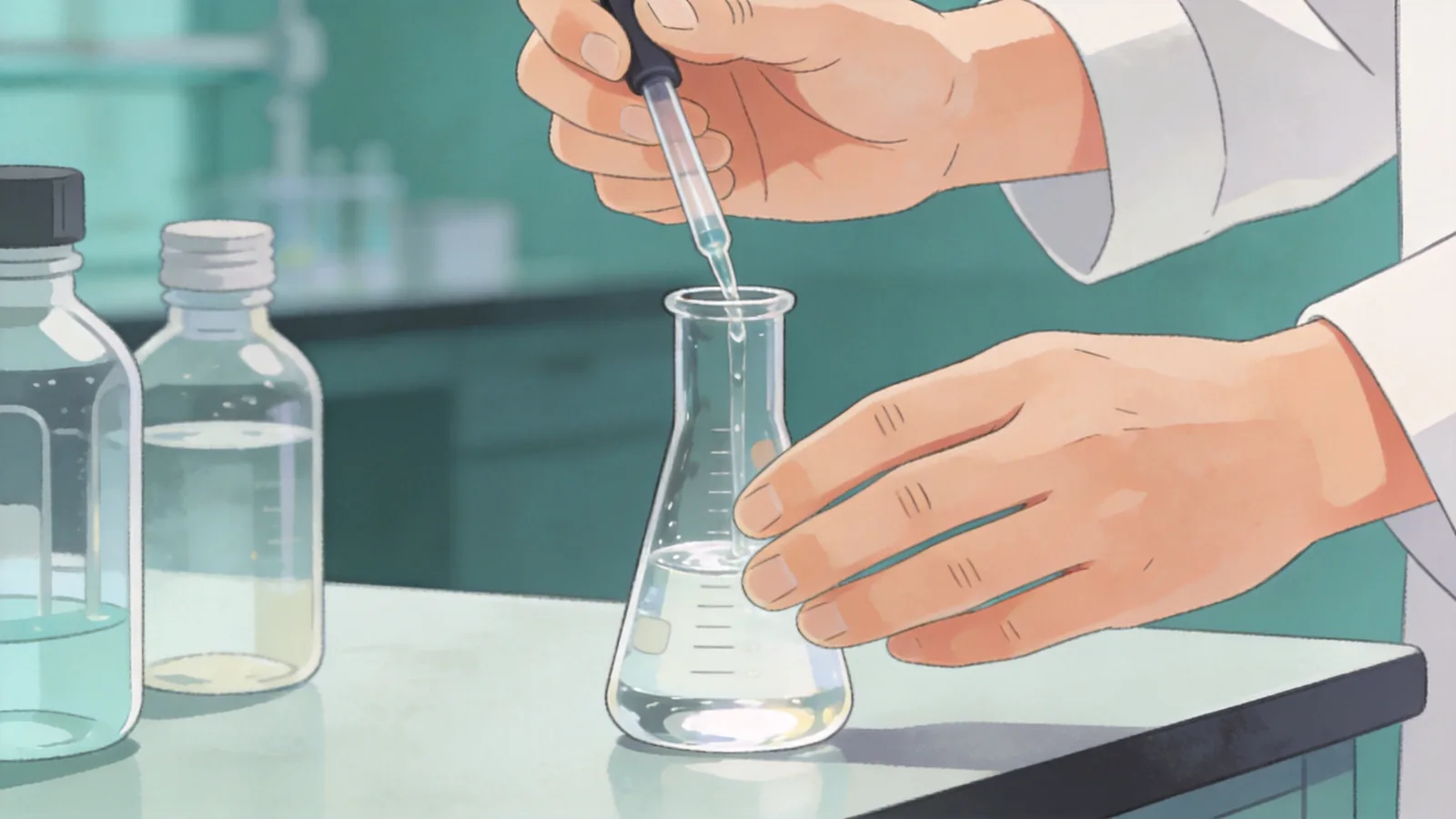
A buffer is a mixture of a weak acid (HA) and its conjugate base (A⁻) that resists pH change when small amounts of strong acid or base are added. Laboratory recipes specify a named system (phosphate, potassium phosphate, HEPES, MES, borate, acetate, Tris, citrate, ammonia, bicarbonate, carbonate, histidine, imidazole), a target pH, a total buffer concentration C = [HA] + [A⁻], and a final volume. The Henderson–Hasselbalch equation sets the ratio [A⁻]/[HA] from pH and pKa; together with C it fixes both concentrations, then masses follow from molar mass and volume.
Useful buffering is typically within about ±1 pH unit of the system pKa. Outside that window the ratio becomes extreme and capacity collapses. Real polyprotic systems (citrate, carbonate) have multiple pKa values; this calculator uses a single effective pKa per named recipe as a teaching and planning aid—not a substitute for validated lab SOPs for critical biology or clinical work. Citrate–phosphate (McIlvaine) is two stocks mixed from a published table, not a new pKa: choose the McIlvaine chip for 0.2 M Na₂HPO₄ + 0.1 M citric acid.
The Phosphate Buffer Calculator on Online Science Tools returns acid and base molarities, moles, and grams for common named buffers, plus McIlvaine mixing volumes. Cross-check the target pH with the pH Calculator’s buffer mode, and dilute stock solutions with the Dilution Calculator when needed.
- pH = pKa + log₁₀([A⁻]/[HA]) (Henderson–Hasselbalch)
- C = [HA] + [A⁻]; solve for each concentration from the ratio and C
- mass = moles × molar mass; moles = molarity × volume (L)
- Stay near the system pKa for practical buffer capacity
Formulas you will actually use
Recipe from target pH, total molarity C, and volume V:
pH = pKa + log₁₀([A⁻]/[HA])
r = [A⁻]/[HA] = 10^(pH − pKa)

[HA] = C / (1 + r)
[A⁻] = C − [HA] = C · r / (1 + r)

n_HA = [HA] · V
n_A  = [A⁻] · V
m = n · M (molar mass of the acid or base reagent)- Reagent formulas are the usual lab salts/acids (e.g. NaH₂PO₄ / Na₂HPO₄ for phosphate).
- Ionic strength, temperature, and activity corrections are omitted.
- Tris and citrate recipes are approximate single-pKa models.
Step-by-step example: 0.10 M phosphate buffer, pH 7.40, 1.00 L
Prepare 1.00 L of 0.10 M phosphate buffer at pH 7.40 using NaH₂PO₄ / Na₂HPO₄ (pKa₂ ≈ 7.20).
- r = 10^(7.40 − 7.20) = 10^0.20 ≈ 1.585.
- [HA] = 0.10 / (1 + 1.585) ≈ 0.0387 M; [A⁻] ≈ 0.0613 M.
- moles: n_HA ≈ 0.0387 mol; n_A ≈ 0.0613 mol.
- Masses ≈ 4.64 g NaH₂PO₄ and 8.70 g Na₂HPO₄ (anhydrous formulas).
Select Phosphate, pH 7.40, 0.10 M, 1000 mL in the Phosphate Buffer Calculator and compare the gram amounts.
Step-by-step example: McIlvaine citrate–phosphate, pH 7.0, 20 mL
Prepare 20 mL of McIlvaine citrate–phosphate buffer at pH 7.0 from 0.2 M Na₂HPO₄ and 0.1 M citric acid.
- McIlvaine is a mixing table, not a new pKa.
- At pH 7.0 the 20 mL table is 16.47 mL Na₂HPO₄ + 3.53 mL citric acid.
- Scale both volumes if you need a different final volume (100 mL → ×5).
Choose Citrate–phosphate (McIlvaine), pH 7.00, 20 mL and read the two stock volumes.
Frequently asked questions
Is this a phosphate buffer calculator?
Yes. Choose the Phosphate system for the H₂PO₄⁻ / HPO₄²⁻ pair (sodium salts), or K-phosphate for KH₂PO₄ / K₂HPO₄. Set target pH, total molarity, and volume, and read off the grams of each salt. HEPES, MES, borate, acetate, citrate, Tris, ammonia, bicarbonate, carbonate, histidine, and imidazole systems are also available.
Why warn when pH is far from pKa?
Buffer capacity is highest near pKa. Far away, almost all of the buffer is in one form, so small additions of strong acid or base shift pH sharply. Pick a system whose pKa is close to your target.
Can I use this for biological Tris or PBS recipes?
It gives a useful first estimate from Henderson–Hasselbalch. PBS is phosphate-buffered saline: choose Phosphate for the H₂PO₄⁻/HPO₄²⁻ salts, then add NaCl (and KCl if required) from your protocol—this tool does not add the saline. For published SOPs (hydrates, ionic strength, temperature), follow the lab recipe and verify pH with a calibrated meter.
Does this include HEPES, MES, or borate buffer?
Yes. HEPES (pKa ≈ 7.48) and MES (pKa ≈ 6.15) are Good’s buffers; borate uses boric acid / borate (pKa ≈ 9.24). Select the chip, enter target pH, total C, and volume, and read acid/base grams. These are single-pKa teaching recipes—confirm temperature and hydrates against your SOP.
Is this a citrate phosphate buffer calculator?
Yes. Choose Citrate–phosphate (McIlvaine): it interpolates the classic 0.2 M Na₂HPO₄ + 0.1 M citric acid table for pH 2.2–8.0 and scales the mix to your final volume. That is two stocks mixed, not a new pKa. Verify with a meter. For a single-pKa recipe, calculate citrate or phosphate separately instead.
Does this include histidine or imidazole buffer?
Yes. Histidine uses the imidazole side-chain pKa ≈ 6.04 (His·HCl / His). Imidazole uses pKa ≈ 7.00 (imidazole·HCl / free base). Both are single-pKa teaching recipes—confirm temperature and hydrates against your SOP.
How does this relate to the pH Calculator?
The pH Calculator estimates pH from known [HA] and [A⁻]. This tool inverts the problem: given target pH and total C, it finds the recipe amounts. Use both to cross-check homework and lab prep.
References & further reading
Standards bodies, university open courseware, and peer-reviewed references that align with the methods used on this page.
Keep learning with chemistry calculators, the math tools, and study guides on Online Science Tools.