Dilution calculator: C₁V₁ = C₂V₂ and serial dilutions
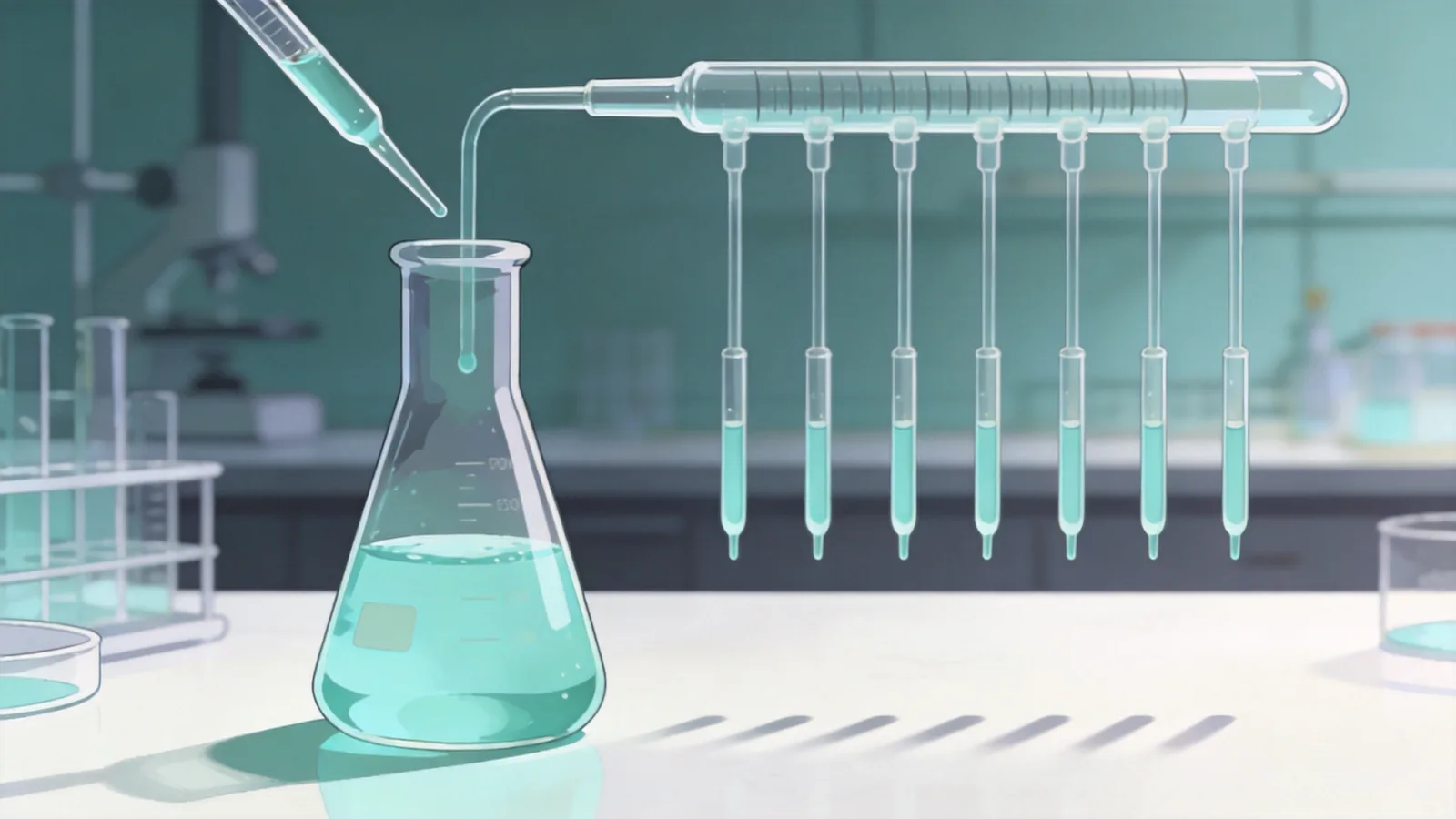
Dilution is the process of lowering a solution’s concentration by adding solvent. In teaching labs and homework, the working relation is almost always C₁V₁ = C₂V₂: the amount of solute is conserved when you dilute, so the product of concentration and volume stays constant if concentration units are consistent.
Typical tasks include preparing a working solution from a concentrated stock, finding how much stock to pipette into a volumetric flask, or checking what concentration results after combining a known aliquot with solvent up to a final volume. The Dilution Calculator solves for whichever one of C₁, V₁, C₂, or V₂ you leave blank.
Keep units consistent. If volumes are in milliliters, both V₁ and V₂ should be in milliliters (or both in liters). Concentrations may be molarity, percent, mg/mL, or another shared unit—the algebra is the same. Use the serial dilution mode for 1:10 / 1:20 / 1:200 / 1:1000 or 10× / 100× steps, or lab presets such as concentrated HCl, H₂SO₄, alcohol, bleach, antibody 1:1000, DNA 10×, and primer 100 μM → 10 μM.
- Solute amount is conserved: moles before = moles after (for non-reactive dilution)
- C₁V₁ = C₂V₂ with matching concentration units and matching volume units
- Stock concentration C₁ is greater than or equal to the diluted concentration C₂
Formulas you will actually use
For a dilution that does not consume or produce solute, the conserved quantity is concentration × volume.
C₁V₁ = C₂V₂

Solve for one unknown, for example:
  V₁ = (C₂V₂) / C₁
  C₂ = (C₁V₁) / V₂

Dilution factor = C₁ / C₂ = V₂ / V₁- Volumes may be mL or L as long as both sides match.
- Do not mix mass percent with molarity in the same equation without converting first.
Step-by-step example: Preparing 250 mL of 0.50 M HCl from 2.0 M stock
You have 2.0 M HCl stock and need 250 mL of 0.50 M HCl. What volume of stock should you measure before diluting to the mark?
- Identify knowns: C₁ = 2.0 M, C₂ = 0.50 M, V₂ = 250 mL; solve for V₁.
- V₁ = (C₂V₂) / C₁ = (0.50 × 250) / 2.0 = 62.5 mL.
- Measure 62.5 mL of stock and dilute with water to 250 mL total volume.
- Check: dilution factor = 2.0 / 0.50 = 4, and 250 / 62.5 = 4.
In the Dilution Calculator, enter C₁ = 2.0, leave V₁ blank, C₂ = 0.50, V₂ = 250 (mL). Confirm V₁ ≈ 62.5 mL.
Frequently asked questions
Is this a C₁V₁ = C₂V₂ dilution calculator?
Yes. Leave one of C₁, V₁, C₂, or V₂ blank and the tool solves C₁V₁ = C₂V₂. Dilution factor is C₁/C₂ = V₂/V₁. Switch to serial mode for 1:10, 1:20, 1:200, 1:1000, or 10× / 100× series, or use the HCl, H₂SO₄, alcohol, bleach, antibody, DNA, and primer presets.
Can I use mL and L in the same calculation?
Only if you convert so both volumes use the same unit. 250 mL is 0.250 L. Mixing units without converting gives a wrong V₁ by a factor of 1000.
Does C₁V₁ = C₂V₂ work for mass percent?
It works when both concentrations are the same type and the density does not change much, which is reasonable for dilute aqueous solutions. For precise work with concentrated solutions, convert to moles or use mass of solute instead.
What is a serial dilution?
A serial dilution repeats dilution in steps (for example, 1:10 three times). Each step still obeys C₁V₁ = C₂V₂. The overall dilution factor is the product of the step factors. Switch the Dilution Calculator to Serial dilution, set factor = 10 with transfer 1 into final 10, and read each tube concentration.
How do I do a 1:10 dilution calculator workflow?
A 1:10 step means the diluted concentration is one-tenth of the stock for that step (dilution factor 10). In simple mode, leave V₁ blank with C₁ known, set C₂ = C₁/10, and enter V₂. In serial mode, choose the 1:10 or 10× chip so transfer/final volumes match the factor. The same pattern applies to 1:50, 1:400, 1:1000, and 100× → 1×.
How do I dilute concentrated HCl or H₂SO₄ stock?
Use the HCl 12 M → 1 M or H₂SO₄ 18 M → 1 M lab chips, which solve C₁V₁ = C₂V₂ for the stock volume V₁. Concentrated-acid molarities are approximate (≈12 M HCl, ≈18 M H₂SO₄). Always add acid to water, never the reverse, and use a published density table if you need a more exact stock concentration.
Can I use this as an antibody, DNA, or primer dilution calculator?
Yes. C₁V₁ = C₂V₂ does not care whether the unit is M, mg/mL, μM, or a relative titer. Use the Antibody 1:1000, DNA 10× → 1×, or Primer 100 μM → 10 μM chips, or type mg/mL (or μM) as the concentration unit and leave V₁ blank. Serial mode covers 1:10 / 1:100 / 1:1000 series.
What is a 1:20 or 1:200 dilution?
Those ratios mean dilution factors of 20 and 200 (C₂ = C₁/20 or C₁/200). Choose the 1:20 or 1:200 chip: in simple mode the tool sets C₂ from your stock C₁ and solves for V₁; in serial mode it sets the step factor and matching transfer/final volumes. The same chips exist for 1:50, 1:400, and 1:1000.
References & further reading
Standards bodies, university open courseware, and peer-reviewed references that align with the methods used on this page.
- LibreTexts / OpenStax — Molarity (includes dilution)Molarity and the C₁V₁ = C₂V₂ dilution relation.
- NIST — Guide for the Use of the International System of UnitsUnit conventions for volume and amount of substance.
- OpenStax Chemistry 2e — MolarityPrimary OpenStax chapter on solution concentration and dilution.
Keep learning with chemistry calculators, the math tools, and study guides on Online Science Tools.