What is the Redox Equation Balancer?
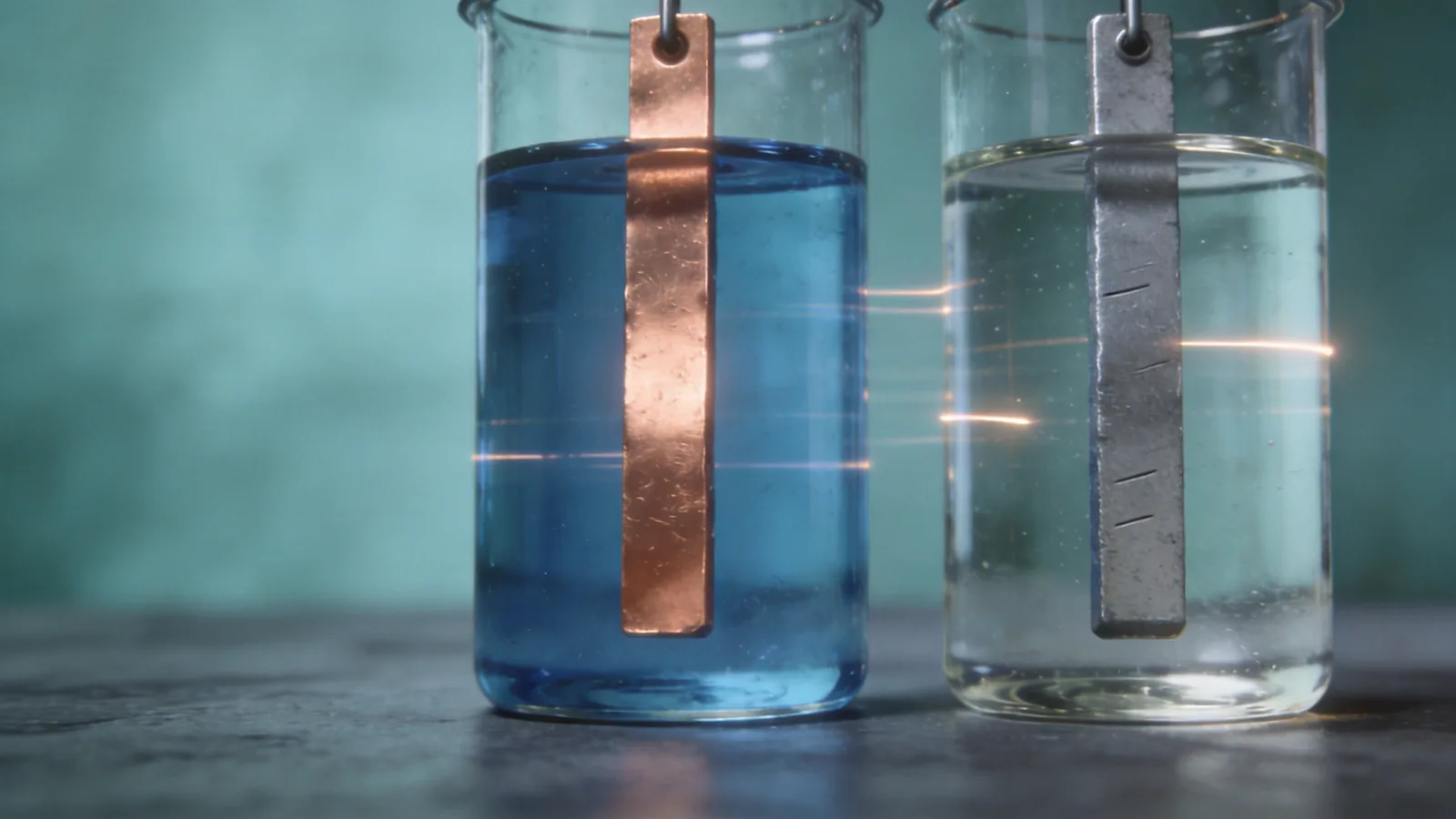
Redox reactions transfer electrons between species: oxidation loses electrons, reduction gains them. Many aqueous redox equations cannot be balanced by inspection alone because oxygen, hydrogen, and charge must be adjusted together with the principal atoms. The half-reaction method (ion–electron method) separates oxidation and reduction, balances atoms and charge in each half, then combines them so electrons cancel.
In acidic medium, oxygen is balanced with H₂O and hydrogen with H⁺. In basic medium, the same acidic skeleton is converted by adding OH⁻ to neutralize H⁺, producing water on one side and leaving net OH⁻ where needed. Both atom counts and net charge must match on the reactant and product sides of the final equation.
The Redox Equation Balancer on Online Science Tools accepts ionic or molecular skeletons such as MnO4- + Fe2+ = Mn2+ + Fe3+, chooses acidic or basic medium, and returns the smallest whole-number equation with step notes and an atom/charge check. Use it to verify homework half-reaction work, then carry coefficients into the Limiting Reagent Calculator when yields matter.
- Split into oxidation and reduction half-reactions when needed
- Acidic: balance O with H₂O, H with H⁺, then charge with e⁻
- Basic: convert H⁺ by adding equal OH⁻ (H⁺ + OH⁻ → H₂O)
- Electrons lost must equal electrons gained before adding halves
Formulas you will actually use
Conservation constraints for a redox equation in aqueous solution:
For every element X:
  Σ atoms(X)_reactants = Σ atoms(X)_products

Charge:
  Σ (coeff × charge)_reactants = Σ (coeff × charge)_products

Acidic half-reaction pattern (example MnO₄⁻ → Mn²⁺):
  MnO₄⁻ → Mn²⁺
  MnO₄⁻ → Mn²⁺ + 4H₂O
  MnO₄⁻ + 8H⁺ → Mn²⁺ + 4H₂O
MnO₄⁻ + 8H⁺ + 5e⁻ → Mn²⁺ + 4H₂O- Write ion charges as Fe2+, MnO4-, or with carets (SO4^2-).
- Spectator ions may be omitted in net ionic redox equations.
- If the skeleton already includes H₂O / H⁺ / OH⁻, the balancer may still adjust them.
Step-by-step example: Permanganate oxidizing Fe²⁺ (acidic)
Balance MnO₄⁻ + Fe²⁺ → Mn²⁺ + Fe³⁺ in acidic aqueous solution.
- Reduction: MnO₄⁻ → Mn²⁺; add 4 H₂O, then 8 H⁺, then 5 e⁻.
- Oxidation: Fe²⁺ → Fe³⁺ + e⁻.
- Multiply the iron half by 5 so electrons cancel (5e⁻).
- Add: MnO₄⁻ + 5Fe²⁺ + 8H⁺ → Mn²⁺ + 5Fe³⁺ + 4H₂O.
- Check: Mn, Fe, O, H atoms and net charge (+17) match on both sides.
Enter MnO4- + Fe2+ = Mn2+ + Fe3+, choose Acidic, and confirm the same coefficients in the Redox Equation Balancer.
Frequently asked questions
Is this a half reaction calculator for acidic and basic media?
Yes. Choose acidic or basic medium. The tool balances atoms and charge, adding H₂O, H⁺, or OH⁻ as required, and shows steps plus an atom inventory so you can compare with hand-worked half-reactions.
How do I enter ion charges?
Append the charge after the formula: Fe2+, Zn2+, MnO4-, or use a caret for polyatomic ions such as Cr2O7^2- and SO4^2-. Neutral species like Zn, H2, and MnO2 need no charge suffix.
When should I use basic medium?
Use basic when the reaction occurs in alkaline solution or the expected products include OH⁻ (for example permanganate to MnO₂ with sulfite in base). Switching medium changes how H⁺/OH⁻/H₂O appear in the final equation.
How is this different from the Chemical Equation Balancer?
The general balancer conserves atoms for molecular equations. The redox balancer also conserves charge and can introduce solvent-derived H₂O, H⁺, and OH⁻ that were not in your skeleton—essential for aqueous half-reaction problems.
References & further reading
Standards bodies, university open courseware, and peer-reviewed references that align with the methods used on this page.
Keep learning with chemistry calculators, the math tools, and study guides on Online Science Tools.